
Cerebra Cerebra

Decisions,
deployed in milliseconds

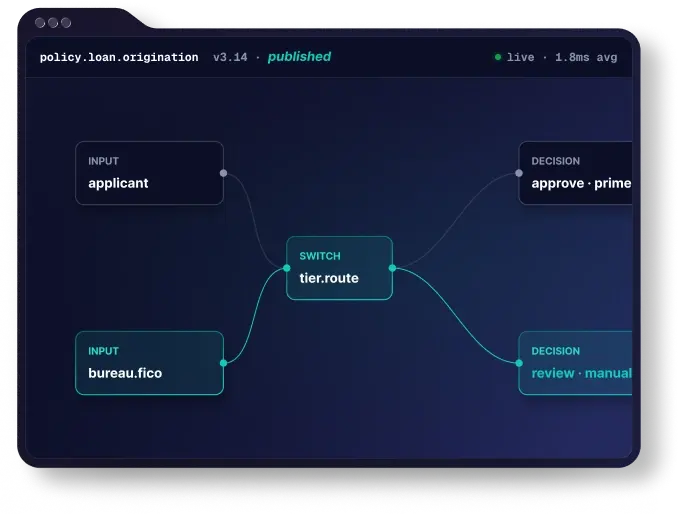
Cerebra is a modern BRMS — author business rules as visual decision graphs, version them like code, and serve them from a managed API at single-digit-millisecond latency. The decision engine your risk team and your engineers both like.

Cerebra decision graph: policy.loan.origination routing applicant and bureau.fico inputs through a tier.route switch to approve and review decisions
The Problem

Business rules are the most important code at your company, and no one treats them like code.

01

Legacy BRMS are slow to change.

A risk team writes a rule. Engineering writes a JIRA. Six weeks later, an appliance ships. By then the policy is wrong, the consultant is paid, and the deal is dead.

02

Spreadsheets and code drift apart.

The policy doc says one thing. The Python service does another. The Excel sheet underwriters actually use does a third. No one knows which one decided.

03

Auditors want a story you can’t tell.

“Why did you decline this customer on March 4th?” The honest answer involves a deploy log, a deleted branch, and a developer who left in May.

HOW IT WORKS

Three primitives.
One request path.

  1. 01

    Author

    Compose SwitchRules, decision tables, and Compute nodes in the browser. CEL expressions for predicates – sandboxed, fast, familiar to anyone who has touched Kubernetes.

    if income > 80_000
    prime approve
    near-prime review
    subprime decline
  2. 02

    Publish

    Cerebra compiles the graph to an in-memory program, hashes it with SHA-256, and writes the result to an append-only registry. A reviewer signs off. The pointer flips.

    v3.14 9f4ea201… live
    v3.13 7c12bb83… rollback
    v3.12 a90f1e44…
    v3.11 b521e93c…
  3. 03

    Evaluate

    Your service POSTs JSON. Cerebra resolves the live registry, runs the program lock-free, returns a decision and the exact node path that produced it. Every call is recorded.

    P500.9ms
    P952.4ms
    P994.2ms
THE LANDSCAPE

What you replace, and
what you stop building.

How Cerebra compares to legacy BRMS vendors and building it yourself
Capability Cerebra IBM ODM FICO Blaze DIY service
Authoring Visual graph + CEL Eclipse-based BOM tooling Excel + proprietary DSL Whatever you can ship in a quarter
Deployment Managed SaaS, multi-region WAS appliance On-prem appliance Your monorepo
Versioning SHA-256, atomic swap Project import/export Manual snapshots git tag, fingers crossed
Audit trail Per-call, append-only Add-on module Add-on module You’ll get to it
P99 latency ~4 ms up to 250 ms up to 80 ms Depends on the intern
Runtime Rust, no JVM JVM, proprietary JVM, proprietary JVM, proprietary
Pricing posture SaaS · usage-based · $499/mo $1M+ & consultants $500K+ license & SI Headcount
First rule shipped An afternoon Two quarters One quarter “Q3, maybe Q4”
Built for regulated workloads

Every decision has a paper trail. Yours can have one too.

Lending, KYC, fraud, claims, eligibility. The decisions auditors care about most are the ones engineers have the least time to instrument.

  • Four-eyes review Every publish requires a second signer. The signer is recorded with the version.
  • Replay against draft Pipe the last 24h of production traffic at a draft graph. See what would have changed before it changes.
  • Atomic rollback Any prior version is one click away. The swap is lock-free; in-flight requests finish on the old version.
  • Append-only log Input, output, fired node, exact program hash. Sign it, ship it to your warehouse, hand it to your regulator.
Architecture you can trust

A small, boring footprint that earns its keep in the request path.

  • Core Rust

    Single static binary. No JVM, no proprietary runtime, no agent.

  • Storage Postgres

    Battle-tested, replicated, point-in-time recoverable. The boring choice, on purpose.

  • Interface HTTP + gRPC

    One POST /api/evaluate .JSON in, decision out. Drop in.

  • Hosted Managed SaaS

    Multi-region by default. Dedicated single-tenant regions on Enterprise. No infra for you to run.

  • Identity OIDC + SCIM

    Map your existing groups to author / reviewer / publisher.

  • Memory ~80 MB resident

    Programs are in-memory; evaluations are lock-free atomic reads.

WHERE IT SHIPS

Same primitives. Every regulated decision in the request path.

A SwitchRule is a SwitchRule whether it routes a loan or a claim. Pick an industry — see the graphs Cerebra is built to run.

  • Eligibility Loan origination Bureau pull → tier → instant approve / manual review.
  • Pricing & risk Rate-tier pricing APR bands by FICO, DTI, and tenure.
  • Fraud & AML Application fraud Device, velocity, and ID-document signals.
  • KYC / identity Onboarding KYC Sanctions, PEP, address-history thresholds.
  • Limits & auth Credit-line set Initial line and step-up schedule.
  • Workflow routing Manual review Queue assignment by complexity and SLA.
  • Eligibility Account opening Product fit by age, residency, and risk band.
  • Pricing & risk Rate-tier pricing APR bands by FICO, DTI, and tenure.
  • Fraud & AML Application fraud Device, velocity, and ID-document signals.
  • KYC / identity CDD refresh Risk-tier triggered re-verification.
  • Limits & auth Overdraft policy Pay vs return, grace windows, opt-in rules.
  • Workflow routing Dispute routing Reg E vs Reg Z, chargeback path selection.
  • Eligibility Underwriting Geo, age, occupation, prior-claims gating.
  • Pricing & risk Premium quote Base rate × factor stack, capped per region.
  • Fraud & AML Claim fraud scoring Pattern matching against prior FNOL signals.
  • KYC / identity Carried by the distribution partner.
  • Limits & auth Coverage caps Sub-limits by peril, territory, and rider.
  • Workflow routing Auto-settle FNOL Straight-through pay-out vs adjuster review.
  • Eligibility Issuance check BIN, residency, and program-rule gating.
  • Pricing & risk Interchange tier MCC × volume × program assignment.
  • Fraud & AML Velocity scoring Real-time tx scoring at sub-ms tail latency.
  • KYC / identity Merchant KYB Beneficial owners, sanctions, industry risk.
  • Limits & auth Auth & tx limits Cardholder, merchant, and program ceilings.
  • Workflow routing 3DS step-up Frictionless vs challenge by risk score.
  • Eligibility Prior authorization CPT × diagnosis × plan policy resolution.
  • Pricing & risk Reimbursement codes Fee schedules and modifier handling.
  • Fraud & AML Claim audit Upcoding, unbundling, frequency anomalies.
  • KYC / identity Handled upstream by the enrolment system.
  • Limits & auth Visit & benefit caps Annual, per-condition, network-tier limits.
  • Workflow routing Triage routing Severity-based queue and clinician matching.
  • Eligibility Plan eligibility Geo, device-IMEI, and bundle compatibility.
  • Pricing & risk Promo eligibility Loyalty, churn-risk, and tenure tiers.
  • Fraud & AML SIM-swap risk Step-up auth on suspicious port requests.
  • KYC / identity Subscriber KYC ID document & address-of-record check.
  • Limits & auth Credit limit Post-paid spend caps by tier and history.
  • Workflow routing Port-in routing Wholesale partner selection by geo.
  • Eligibility Geo eligibility Jurisdiction × age × product permission.
  • Pricing & risk Bonus eligibility Welcome, reload, loyalty offer gating.
  • Fraud & AML Bonus abuse Multi-account & collusion detection.
  • KYC / identity Affordability KYC Income, source-of-funds, and SoW triggers.
  • Limits & auth Stake & loss caps Daily / weekly / lifetime limits per region.
  • Workflow routing Self-exclusion National-register sync & account closure.
  • Eligibility Benefit eligibility Income, household, and program-rule resolution.
  • Pricing & risk Benefits are statutory, not priced.
  • Fraud & AML Benefit fraud Anomaly detection across cross-program data.
  • KYC / identity ID verification National-ID match and proof-of-residence rules.
  • Limits & auth Statutory caps, encoded directly in the law.
  • Workflow routing Appeals routing Tribunal assignment by case type and tenure.
Flagship example we demo Supported · build it in an afternoon Not applicable in this industry
in the wild

Three shapes of policy.
The same three primitives.

Lending

Loan origination

Pull bureau and income, tier the applicant, route to instant-approve or manual review. 47 rules. One graph. Underwriters edit it themselves.

Decisions/day
1.2M
P99
2.8 ms
Author
Risk team
Fraud

Transaction scoring

Velocity, device, geo, merchant category, and a model score. Six branches, two outcomes — pass or hold for review. Every threshold is a version.

Decisions/day
38M
P99
1.4 ms
Author
Fraud ops
Insurance

Underwriting eligibility

Geography, age, occupation, coverage limits. The graph reads like the underwriting manual — because the underwriting team wrote it.

Decisions/day
96K
P99
4.6 ms
Author
Underwriting
developer experience

It’s just an API.

No SDK to vendor. No DSL to learn. No agent to install. POST a payload, read a decision. The reverse-loop is the same — push a graph, get back a version hash.

  • SDK Optional. Generated from the OpenAPI spec.
  • Tracing OpenTelemetry on every evaluate call.
  • Local docker run cerebra/dev on your laptop.
  • CI Diff a draft against prod. Fail the build if behavior changes.
$ curl
$ curl -X POST https://api.cerebra.io/v1/evaluate \
  -H "Authorization: Bearer $CEREBRA_KEY" \
  -H "Content-Type: application/json" \
  -d '{
    "graph": "policy.loan.origination",
    "input": {
      "applicant": { "income": 92000, "dob": "1989-04-12" },
      "bureau":    { "fico": 742, "delinq_24m": 0 }
    }
  }'
200 OK · 3.4ms cerebra-trace-id: 9f4e…a201
{
  "decision": "approve",
  "tier":     "prime",
  "fired_node": "tier.route#3",
  "node_path": ["applicant", "tier.route", "approve"],
  "version":   "3.14",
  "program_sha": "9f4ea201bc54…",
  "latency_ms": 3.4
}
pricing

Priced like infrastructure,
not like an appliance.

No per-seat tax on your risk team. No five-figure procurement to ship one rule. Pay for evaluations and graphs — the things that actually scale with your business.

Basic

For teams shipping their first decisions in production.

$499 / month
Start free trial
  • Up to 3 decision graphs
  • 500K evaluations / month
  • 30-day audit retention
  • Visual graph authoring
  • CEL expressions, replay sandbox
  • Slack-channel support

Enterprise

For regulated workloads, dedicated regions, and named support.

Custom annual
Talk to sales
  • Unlimited graphs & evaluations
  • Indefinite, signed audit retention
  • Dedicated single-tenant region
  • SCIM, custom roles, IP allow-listing
  • Custom SLA up to 99.99%
  • Named SE + quarterly security review
  • Procurement, MSA, DPA, your paper

All plans · SOC 2 Type II · OpenTelemetry on every call · Region: us-east, eu-west, ap-south

Move your rules
out of spreadsheets,
COBOL, and consultancy
invoices.

A 30-minute call. We bring a real graph. You bring a hard one. We’ll show you exactly what you’d build, deploy, and instrument by Friday.

cerebra@cerebra.io  ·  SOC 2 Type II  ·  ISO 27001 (in progress)