Comparison · Updated for Blaze Advisor 7.5 · 5 min read

CerebravsFICO Blaze Same decisions. One-tenth the overhead.

Blaze Advisor is the engine that ran credit policy at most of the world's banks for the last twenty years. It still does. We don't argue that. We argue that the next twenty years look different — that policy lives in source control, ships through a pipeline, and answers a request in a digit of milliseconds. Here is what changes when a team moves a Blaze workload onto Cerebra, and where Blaze is still the right answer.

P99 evaluation · Cerebra 4.2ms Rust runtime, ahead-of-time compiled graph
P99 evaluation · Blaze 40–90ms JVM + RETE, customer-reported
First rule shipped · Cerebra Oneafternoon No appliance, no SI, no ticket
First rule shipped · Blaze Onequarter+ RMA setup, BOM, SI engagement
short version

The case for switching, in eight bullets.

We've kept it honest. Blaze is older, heavier, and deeper. Cerebra is faster, lighter, and tighter. Whether that trade is right depends on the workload — read on for where each one wins.

Cerebra Why teams switch
  • Single-digit-ms P99 from a Rust runtime — no JVM warm-up, no RETE pathology on wide rulesets.
  • Versioning, fully managed. Every publish is SHA-256 content-addressed, atomic, and reversible in one click. Diff, pin, or roll back to any past version from the cockpit — no archive promotion ceremony, no "which RMA snapshot did this?"
  • Audit by default. Every call writes the fired-node trace, the input hash, the version. Not an add-on module — the only mode.
  • One pricing line. Usage-based SaaS that starts at $499/month, not $500K+ and a system-integrator master agreement.
FICO Blaze What it still wins on
  • FICO ecosystem. Score Cards, Decision Optimizer, DMP — if your workflow already crosses three FICO products, switching is a different shape of cost.
  • Deep BOM modeling. 20-year-old class libraries, business object templates, vertical reference packs. Cerebra ships graphs, not class trees.
  • Mainframe-adjacent footprint. Blaze has shipped into z/OS-flanked stacks since 2003. Cerebra runs on-prem, in your VPC, or as managed SaaS — but we won't pretend a fresh-from-the-vendor deploy carries the same institutional comfort as twenty years of Blaze appliances in the same rack.
  • "Nobody got fired" risk profile. If your evaluation criterion is procurement risk, not engineering velocity, Blaze is the safer status-quo answer. We can't outrun that — only outwork it.

How we evaluated: public Blaze Advisor 7.5 documentation, four migrations completed in the last 18 months (auto-finance, KYC, claims, eligibility), and one engagement we lost. Numbers in this page are illustrative for a typical mid-sized lender workload — your mileage will vary; we'll re-benchmark against yours in a 30-minute call.

side by side

Twenty rows, four
sections, no asterisks.

Feature-by-feature comparison of Cerebra and FICO Blaze Advisor across authoring, runtime, operations, and commercial dimensions.
Capability Cerebra FICO Blaze Advisor
Authoring & modelling
Authoring surfacewhere rules are written cerebraBrowser-based visual decision graph. Risk team drags nodes; engineers see the same graph rendered as readable YAML in the cockpit. One model, two views — not two products to keep in sync. blazeRule Maintenance Application (RMA) for business users; Blaze Advisor IDE (Eclipse-based) for developers. Two tools, two mental models.
Rule languagethe DSL itself cerebraCEL (Google's Common Expression Language) — open, typed, embeddable, with a published grammar. Engineers already know it. blazeSRL — Structured Rule Language. Proprietary, English-shaped, deeply expressive, but only Blaze speaks it. Hiring is harder than it should be.
Decision tables cerebraFirst-class node type, with column-level type checks and uniqueness/coverage analysis in the editor. blazeFirst-class. Mature, well-loved by underwriters, with the caveat that import/export goes through Excel and that's how drift happens.
Business Object Model cerebraJSON schema at the graph boundary. No separate "BOM" to ship. Rename a field, run replay, see what would have changed. blazeFull BOM authored in the IDE, mapped to underlying XOM (Java/XSD). Powerful, and a project of its own.
Runtime
Inference engine cerebraSequential decision graph, ahead-of-time compiled. No working memory, no agenda, no surprises. Deterministic by construction. blazeRETE-class forward-chaining inference with sequential modes available. Powerful for set-based rule matching; less suited to per-request scoring.
Hosting platform cerebraRust binary, no JVM, no container of containers. Ships as managed SaaS, in-VPC, or fully on-prem — same binary, your call. blazeJVM (Java 8/11/17 depending on version). Customer-hosted: app server, container, or Rules Solution Manager. You pick, you operate.
P99 latency, typical mid-size lender cerebra~4 ms, including audit write. Cold-start under 80 ms. blaze40–90 ms warm, customer-reported. Cold-start can hit several seconds on the JVM after deploy.
Throughput ceiling cerebraHorizontally elastic — usage-based pricing scales with you, no node licensing. blazeBounded by the JVMs you've licensed. Adding capacity is a procurement event, not a slider.
Operations, versioning & audit
Versioning model cerebraSHA-256 content-addressed graphs. Every publish gets a hash. Promote, pin, or roll back by hash, atomically. blazeProject snapshots in the rule repository. Promotion goes through deployment events. Workable, but it isn't Git.
Audit trail cerebraEvery evaluation writes input hash, fired nodes, decision, version, signer to an append-only log. Default. Always on. blazeAvailable through Decision Insight / DMP add-ons and additional FICO modules. Often a separate license and a separate database.
Replay against draft cerebraPipe the last 24 h of production traffic at a draft graph; see the diff before you publish. One click. blazeTest scenarios in RMA against curated datasets; production-traffic replay is a custom build for most customers.
Four-eyes / dual approval cerebraBuilt-in. Publish blocks until a second signer approves; signer identity is sealed into the version hash. blazeAvailable through workflow configuration; typically lives in Decision Center governance, sometimes outside Blaze itself.
Commercial & ergonomics
Pricing posture cerebraSaaS, usage-based. Public list price starts at $499/month. Enterprise tiers without a master-agreement marathon. blazeEnterprise perpetual or subscription; commonly mid-six to seven figures inclusive of SI. Pricing is not public.
Time-to-first-decision cerebraSign up, paste a JSON sample, draw a graph, POST. An afternoon, no SI required. blazeOne quarter is fast. Two quarters is honest. Most enterprise rollouts include an SI engagement.
Developer ergonomics cerebraREST + gRPC, OpenAPI, typed SDKs (TS, Go, Python, Rust). One POST /evaluate. Versions are URLs. blazeJava client libs, SOAP/REST through Rules Solution Manager, custom adapters for non-JVM stacks.
Best-fit workload cerebraReal-time per-request decisions: lending decisions, KYC, fraud routing, eligibility, dynamic pricing. blazeHeavy batch credit/insurance underwriting where Score Cards and DMP carry weight; deep on-prem mainframes.
Architecture

The stack you operate,
and the one you don't.

Blaze is a great runtime sitting under several boxes you have to keep running. Cerebra is a managed endpoint sitting under one HTTP call you have to keep calling.

FICO Blaze Advisor Customer-operated
L1
Rule Maintenance Application (RMA)Web UI for business users, deployed per environment
L2
Blaze Advisor IDEEclipse plugin — BOM, SRL, ruleflows
L3
Rule RepositoryRDBMS (Oracle / DB2 / SQL Server) — projects, snapshots, lock state
L4
Rule Solutions ManagerPackaging & promotion across envs
L5
Blaze RuntimeJVM service, hosted in your app server or container
L6
Decision Insight / DMP add-onsFor audit, dashboards, A-B — separately licensed
Things you operateSix
Licenses to track2 – 5
Cerebra Managed
L1
Decision CockpitVisual graph editor, replay, version diff, governance — one browser app
L2
Cerebra RuntimeRust binary, content-addressed graphs, single-digit-ms P99 — SaaS, VPC, or on-prem
L3
Model storeEvery published graph is persisted as an SHA-pinned version. Diff, pin, rollback — transparent.
L4
Audit LogAppend-only, per-call, default. No add-on.
Things you operateZero
Licenses to trackOne
Authoring, in two screens

“If tier is prime, approve”
— how each tool spells it.

A trivial slice of a real loan-origination policy, in both worlds. Same logic, different mental load.

Blaze Advisor IDE · loan_origination.srl SRL
// rule: tier.route — approve prime applicants
rule "TierRoute_ApprovePrime"
{
  priority 100;
  when
    an Applicant is a
      where a.income is at least 75000
        and a.bureau.fico is at least 720
        and a.bureau.delinq_24m is 0;
  then
    modify a {
      decision = "approve";
      tier     = "prime";
    };
}

Author this in the IDE, mapped to the BOM. Compile. Package. Promote through RMA. Restart the app server if you changed the BOM.

9 steps · ~3 environments Quarterly cadence
Cerebra · policy.loan.origination graph + CEL
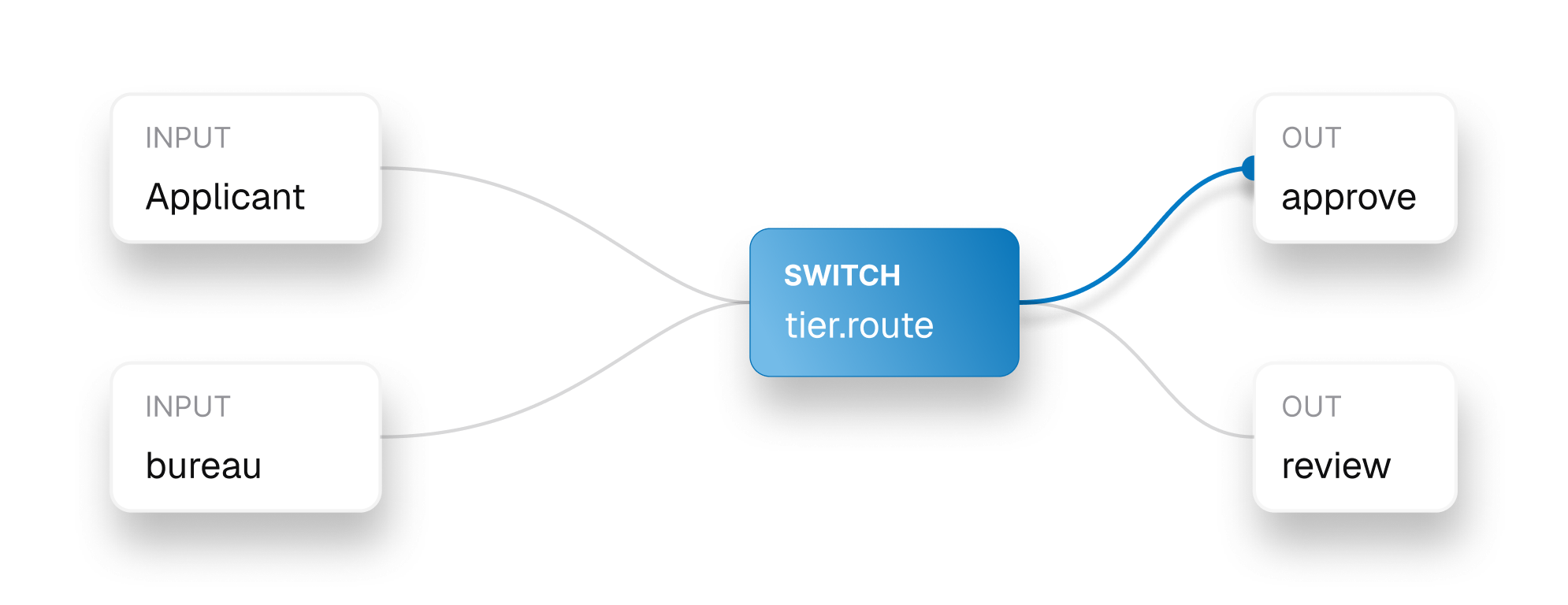
Cerebra node graph: Applicant and bureau inputs route through a tier.route switch to approve or review outputs
# node: tier.route — "prime" branch (CEL)
applicant.income >= 75_000
&& bureau.fico >= 720 && bureau.delinq_24m == 0
# → emits { decision: "approve", tier: "prime" }
1 step · same env Same-day
Latency under load

P50 / P95 / P99, single decision, 1k RPS

  • Cerebra
  • Blaze (warm JVM)
1.1
24ms
P50
2.6
64ms
P95
4.2ms
96ms
P99
P99 reduction 22x 96 ms → 4.2 ms on the same workload
Annualised cost — typical lender ~$1.8M → ~$84K License + SI + ops headcount, then SaaS-only
Caveat Numbers from four 2025 migrations. Your shape is yours; we'll re-run on your real traffic.
Migration path

Six weeks from “let's evaluate” to running shadow traffic.

We don't ask anyone to rip Blaze out on day one. We sit next to it, in shadow mode, until the diffs are zero — and the choice is yours.

Phase 01
Week 0 – 1

Discovery & pilot graph

Pick one decision: a single ruleflow that's been waiting on a release. We turn it into a Cerebra graph together. You keep Blaze running.

Deliverable: 1 pilot graph, hash-pinned
Phase 02
Week 2 – 3

SRL → graph import

For larger workloads, our import tool reads a Blaze project export (.brl + BOM) and produces an opinionated graph. The first pass is rarely perfect; the diff is small enough to review by lunch.

Tool:cerebra import --blaze ./export
Phase 03
Week 4 – 5

Shadow traffic & diff

Fork production traffic to Cerebra in parallel with Blaze. Surface every diff in the cockpit. Risk team signs off rule by rule.

Target: < 0.1% un-explained divergence
Phase 04
Week 6+

Cutover, with the kill switch

Flip the router. Blaze stays warm for two weeks as the fallback. You roll back with one config change if anything looks off — and "anything" is your call.

Rollback: < 60 s, single SHA pin
The honest corner

When you should
stay on Blaze.

  • You're deeply on FICO DMP & Score Cards. If three FICO products are wired into one workflow, the cost of cutover may exceed the savings — at least on the first workload. Start with an adjacent decision that isn't already entangled, then revisit.
  • Your evaluation is procurement-led, not engineering-led. We are a startup. If your scorecard weights "vendor since 1997" above "evaluation latency," we will lose that scorecard fairly. We're happy to lose it; we won't pretend to win it.
  • Your decisioning is already wired into a z/OS-adjacent stack. Cerebra runs on-prem and in-VPC, so the deployment footprint is no longer a blocker — but if Blaze already lives in the same data centre as CICS, IMS, and a DB2 you can't move, the institutional cost of swapping the engine still outweighs the engineering gain. Start with an adjacent decision instead.
  • Your rule logic is heavily set-based, not request-based. If you're running RETE over thousands of facts in working memory to find a single match, that is exactly what Blaze was built for. Cerebra is built for one request, one graph, one answer — fast.

FAQ.

Can you really import an existing Blaze project?

For SRL-defined rulesets and decision tables — yes, mostly. Our import tool reads a Blaze project export plus the BOM, produces an opinionated graph, and flags rules whose semantics don't have a 1:1 mapping (typically priority-driven RETE conflicts and modify-then-rematch patterns). Those get a human in the loop. In four 2025 migrations, the auto-translated portion ranged from 71% to 94% of rule mass.

What about scorecards?

Cerebra has a first-class scorecard node — weighted-attribute scoring with documented bands and reason codes. If you're using FICO Score Cards as a hosted model, Cerebra can call it as an upstream input. If you're authoring scorecards inside Blaze, we re-author them as Cerebra scorecard nodes (which produce the same reason codes, including SR-coded adverse-action outputs).

How does Cerebra handle adverse-action explanations?

Every decision returns the fired-node trace, the reason-code set, and the input projection. The audit log retains those structures for the regulatory retention window you configure (default seven years). The adverse-action letter template is a downstream concern — we don't render it for you, but we hand off the structured reasons in a form your letter service expects.

We're a regulated bank — are you SOC 2 / ISO 27001?

SOC 2 Type II since Q4 2025; ISO 27001 audit in flight, expected Q3 2026. We publish a quarterly trust report and respond to standard CAIQ / SIG questionnaires within five business days.

What happens if Cerebra goes away?

Every published graph can be exported as a signed YAML bundle, with its full version history. The Rust runtime binary is escrowed and standard source-escrow trigger clauses are in our enterprise MSA — if anything ever happens to us, you stand up your latest export against the escrowed binary in your VPC, with no help from us. That's the deal.

Can we run Cerebra and Blaze in parallel during cutover?

That is the recommended cutover. We provide a thin shadow-router (open source, MIT) that forks traffic, diffs decisions, and writes the divergence into the cockpit. Most teams run shadow for 2–4 weeks before cutover; the kill-switch stays available for another 2 weeks past that.

Also comparing

Other tools you
might be weighing.

Move one decision. Keep the rest.

Pick a Blaze ruleset that's been waiting on a release. Six weeks from now you'll be running it in shadow on Cerebra, with the diff at zero. The rest is up to you.