Comparison · Updated for ODM 9.0 & Cloud Pak for Business Automation · 5 min read

CerebravsIBM ODM The same rules. Without the WebSphere.

Operational Decision Manager is the ILOG JRules lineage, repackaged by IBM, hardened over fifteen years, and bundled into Cloud Pak. It runs serious workloads inside serious banks. It also brings Decision Center, Rule Designer, BAL, the BOM, the XOM, the Liberty profile, and the consulting hours required to assemble all of that into a working policy change. Here is what changes when a team moves an ODM workload onto Cerebra — and where ODM is still the right answer.

P99 evaluation · Cerebra 4.2ms Rust runtime, ahead-of-time compiled graph
P99 evaluation · ODM 60–250ms Decision Server on Liberty / WAS, customer-reported
First rule shipped · Cerebra Onebinary SaaS, VPC, or on-prem — same Rust binary
Stack you operate · ODM 7+services Decision Center, Server, DB, Liberty, Insights.
short version

The case for switching, in eight bullets.

ODM is mature, deep, and hard-fought. Cerebra is younger, lighter, and engineered for one job — request-time decisions — done well. Below is what each side actually wins on.

Cerebra Why teams switch
  • One product, one console. Decision Cockpit replaces Decision Center, Rule Designer, the .dsx tooling, and the Liberty admin console. One URL.
  • No JVM, no app server. Rust runtime, content-addressed graphs, single-digit-ms P99. No PVU calculator, no WebSphere Liberty patching window.
  • Versioning, fully managed. Every publish is SHA-256 content-addressed, atomic, and reversible in one click. Diff, pin, or roll back to any past version from the cockpit — no RuleApp archive promotion ceremony.
  • Public, usage-based pricing from $499/month. Not a Cloud Pak entitlement matrix and a six-month procurement.
IBM ODM What it still wins on
  • BAL — natural-language authoring. Business Action Language is genuinely good for non-technical authors. We trade some of that for a visual graph; whether you'd take that trade depends on your team.
  • Decision Center governance. Branches, baselines, queries-as-views, and ruleflows — ODM's governance model is deep and battle-tested. Cerebra covers 80% of it with a tenth of the surface area; the last 20% is ODM-only.
  • Cloud Pak ecosystem. If ODM lives next to BAW, FileNet, and Cognos in the same Cloud Pak — your integration sunk-cost is real. We don't argue otherwise.
  • Cloud Pak operational maturity. If ODM is running inside a hardened Cloud Pak install with your platform team already on call for it, the marginal value of swapping engines is small. Cerebra also runs on-prem and in-VPC, so the footprint isn't the blocker — the surrounding operational sunk-cost is.

How we evaluated: public ODM 9.0 documentation, three migrations completed in the last 18 months (claims adjudication, KYC, eligibility), and one POC we lost to ODM on Cloud Pak. Numbers are illustrative for a typical regulated mid-market workload — your traffic shape will move them; we'll re-benchmark with you in a 30-minute call.

side by side

Twenty rows, four
sections, no asterisks.

Feature-by-feature comparison of Cerebra and IBM ODM across authoring, runtime, operations, and commercial dimensions.
Capability Cerebra IBM ODM
Authoring & modelling
Authoring surfacewhere rules are written cerebraBrowser-based visual decision graph. Same graph for business and engineering — no separate IDE. ibm odmDecision Center web console for business; Rule Designer (Eclipse) for developers. Two products, two skill sets, occasional drift.
Rule language cerebraCEL — Google's Common Expression Language. Open grammar, typed, embeddable. Hire any engineer; they'll be writing by Tuesday. ibm odmBAL (Business Action Language) and ARL (Advanced Rule Language). BAL is great for business users; ARL is a specialty skill.
Object model cerebraJSON schema at the graph boundary. Rename a field, run replay, see what would have changed. No XOM build step. ibm odmBOM (Business Object Model) layered over an XOM (Java classes / XSD). Verbalisation files, virtual methods, navigation phrases. A project of its own.
Decision tables & trees cerebraFirst-class node types. Column-level type checks, hit-policy explicit, coverage analysis in the editor. ibm odmFirst-class. Mature, well-tooled, integrated with Decision Center governance — one of ODM's genuine strengths.
Runtime
Inference engine cerebraSequential decision graph, ahead-of-time compiled to a Rust execution plan. Deterministic. No agenda, no working memory, no salience. ibm odmRETEPlus by default, with sequential and fastpath modes per ruleset. Powerful — and the source of most ODM tuning conversations.
Hosting platform cerebraRust runtime, no JVM, no application server. Ships as managed SaaS, in-VPC, or fully on-prem — same binary, your call. ibm odmJVM, deployed onto WebSphere Liberty, traditional WAS, or container under Cloud Pak for Business Automation.
P99 latency, typical mid-size lender cerebra~4 ms end-to-end including audit. Cold-start under 80 ms. ibm odm60–250 ms warm, customer-reported. Cold-start measured in seconds after RuleApp redeploy.
Scaling cerebraHorizontally elastic on managed infra. Usage-based pricing scales with calls, not cores. ibm odmAdd Liberty replicas; track PVU entitlements; renegotiate. Capacity changes are procurement events.
Operations, versioning & audit
Versioning model cerebraSHA-256 content-addressed graphs, atomic publish, instant rollback. Persisted in the platform's model store — versioning is fully transparent: every change is a diffable, pinnable version. ibm odmDecision Center branches & baselines, RuleApp archives for promotion. Mature workflow, but it isn't Git and engineers feel it.
Audit trail cerebraPer-call, append-only. Input hash, fired nodes, decision, version, signer — written on every evaluation. Default. ibm odmDecision Warehouse + Decision Insights — capable, separately licensed, separately operated. Often a second Db2.
Replay against draft cerebraFork the last 24 h of production traffic at a draft graph. Diff displayed in the cockpit. One click. ibm odmDecision Validation Services lets you run scenario suites against a ruleset; production-traffic replay is typically a custom build.
Four-eyes / dual approval cerebraBuilt into publish flow. Second signer recorded inside the version hash. ibm odmThrough Decision Center activity workflow. Powerful, configurable, and a half-day to set up the first time.
Commercial & ergonomics
Pricing posture cerebraSaaS, usage-based. $499/month starting tier. No master agreement to get to a POC. ibm odmPVU / VPC, or bundled inside Cloud Pak for Business Automation entitlements. Typically seven figures all-in.
Time-to-first-decision cerebraSign up → draw a graph → POST. An afternoon. No SI. ibm odmTwo quarters is fast for an enterprise rollout; IBM Lab Services or a partner is usually in the room.
Developer ergonomics cerebraREST + gRPC, OpenAPI, typed SDKs (TS, Go, Python, Rust). Graphs are URLs; versions are hashes. ibm odmJava RES API (POJO / REST), J2EE adapters, occasional .NET bridges. Non-JVM stacks pay an integration tax.
Best-fit workload cerebraReal-time per-request decisions: loan origination, KYC, fraud routing, eligibility, dynamic pricing. ibm odmSet-based RETE workloads next to BAW/FileNet/Cognos under Cloud Pak — the surrounding integration is the real value.
Architecture

Seven services,
or one HTTP call.

ODM is well-engineered; it is also a lot of moving parts. Cerebra collapses the stack to a managed endpoint, a content-addressed model store, and one browser app.

IBM ODM Customer-operated
L1
Decision CenterWeb console for business authoring & governance
L2
Rule DesignerEclipse-based IDE — BOM/XOM, ARL, ruleflows
L3
Decision Center repositoryRDBMS (Db2 / Oracle / PostgreSQL) holding branches, baselines, activities
L4
Decision Server (RES)JVM runtime — ruleApp archives, the engine
L5
Decision Server InsightsFor event-driven scenarios — separately deployed
L6
Decision WarehouseAudit / dashboards / DVS — another Db2
L7
WebSphere Liberty or Cloud PakThe hosting plane that owns it all
Things you operateSeven
Databases under it2 – 3
Cerebra Managed
L1
Decision CockpitVisual graph editor, replay, version diff, governance — one browser app
L2
Cerebra RuntimeRust binary, content-addressed graphs — SaaS, in-VPC, or on-prem
L3
Model storeEvery published graph is persisted as an SHA-pinned version. Diff, pin, rollback — transparent.
L4
Audit LogAppend-only, per-call, included. Not an add-on.
Things you operateZero
Databases under itZero
Authoring, in two screens

“Approve prime applicants”
— how each tool spells it.

A trivial slice of a real loan-origination policy, in both worlds. Same logic, different mental load.

Decision Center · TierRoute_ApprovePrime SRL
// rule: TierRoute_ApprovePrime
definitions
    set 'the applicant' to an applicant ;
    set 'the bureau'    to the bureau of 'the applicant'

if
    the income of 'the applicant' is at least 75000
    and the fico of 'the bureau' is at least 720
    and the delinq_24m of 'the bureau' is 0
then
    set the decision of 'the applicant' to "approve" ;
    set the tier of 'the applicant' to "prime" ;

Author in Decision Center. Verbalisation tied to the BOM. Build the ruleApp. Promote across environments. Restart the Liberty instance if the XOM changed.

11 steps · ~3 environments Multi-week cycle
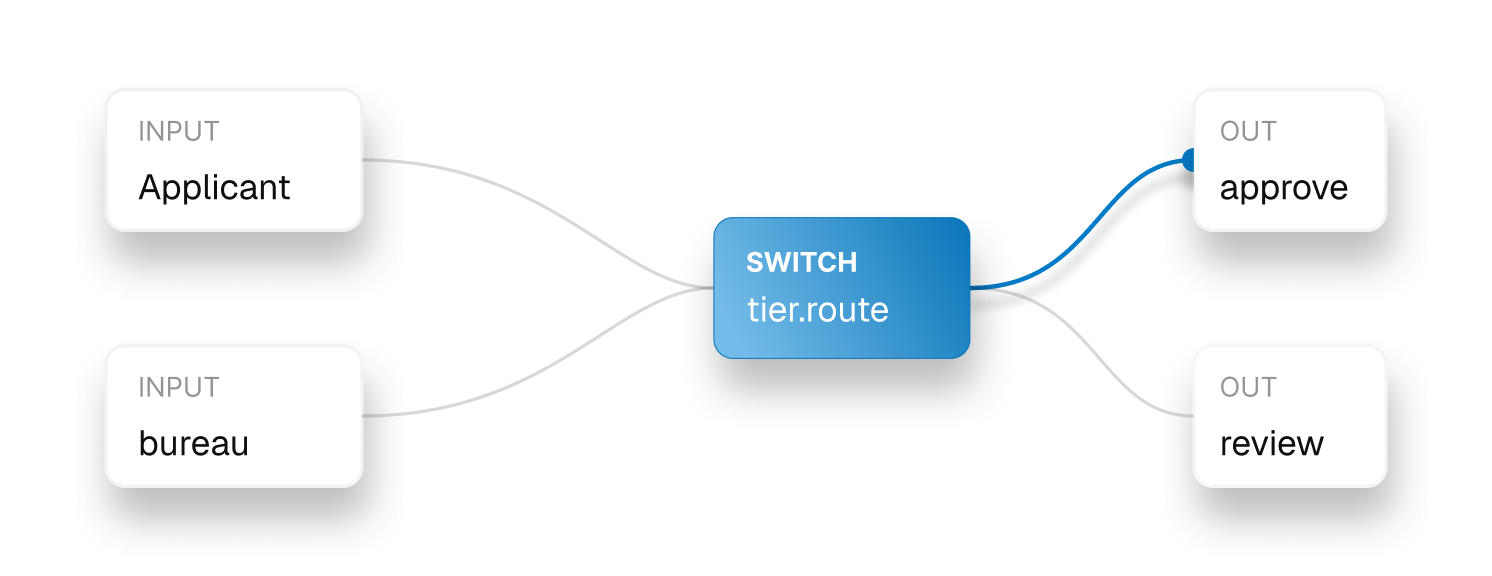
Cerebra · policy.loan.origination graph + CEL
Cerebra node graph: Applicant and bureau inputs route through a tier.route switch to approve or review outputs
# node: tier.route — "prime" branch (CEL)
applicant.income >= 75_000
&& bureau.fico >= 720 && bureau.delinq_24m == 0
# → emits { decision: "approve", tier: "prime" }
1 step · same env Same-day
Latency under load

P50 / P95 / P99, single decision, 1k RPS

  • Cerebra
  • ODM (warm Liberty)
1.1
38ms
P50
2.6
122ms
P95
4.2ms
238ms
P99
P99 reduction ~55× 238 ms → 4.2 ms on the same workload
Annualised cost — typical mid-market ~$2.4M → ~$110K Cloud Pak entitlement + Lab Services + ops vs SaaS line
Caveat Numbers blended across three 2025 migrations. Your shape is yours; we’ll re-run on your real traffic.
Migration path

Six weeks from a Decision Center export to shadow traffic.

ODM stays running. Cerebra sits alongside it. The cutover is a router flip, not a forklift.

Phase 01
Week 0 – 1

Pick one decision service

Choose a single ruleflow — typically the one that’s been blocked behind a release. We mirror it as a Cerebra graph. ODM keeps serving traffic.

Deliverable: 1 pilot graph, hash-pinned
Phase 02
Week 2 – 3

BAL → graph import

Export the decision service as a .dsx from Decision Center. Our importer reads the BOM verbalisations and BAL bodies and produces an opinionated graph. Rules with priority-driven RETE behaviour are flagged for human review.

Tool:cerebra import --odm decision.dsx
Phase 03
Week 4 – 5

Shadow traffic & diff

Fork production traffic to Cerebra in parallel. Every divergent decision lands in the cockpit’s diff view. Risk team signs off rule by rule. Decision Center keeps its baseline.

Target: < 0.1% un-explained divergence
Phase 04
Week 6+

Cutover, with the kill switch

Flip the router. ODM stays warm for two weeks as the fallback. Rollback is one config change — and the choice is yours.

Rollback: < 60 s, single SHA pin
The honest corner

When you should
stay on ODM.

  • You're invested in Cloud Pak for Business Automation. If ODM lives next to BAW, FileNet, and a Cognos report — the integration sunk-cost is real, and the marginal value of moving one decision out is small. Start with an adjacent workload that isn't already wired through Cloud Pak.
  • BAL is the only authoring surface your team will accept. Natural-language BAL is genuinely good. Cerebra's visual graph + CEL trade some of that legibility for tighter governance and faster authoring. If your business users live in BAL, talk to us before switching — the experience is different, and it matters.
  • Your platform team is already operating Cloud Pak. Cerebra runs on-prem and in-VPC, so the deployment shape is no longer the blocker — but if your Cloud Pak install is already humming and the SREs know it cold, the institutional cost of replacing it on day one is real. Start with an adjacent decision and let the comparison play out.
  • Your workload is event-stream, not request-response. Decision Server Insights is built for event-driven, time-windowed rule patterns. Cerebra is built for one request, one graph, one decision, fast. If your rules need to react to a sequence of events over a sliding window, ODM is the closer fit.

FAQ.

Can you import an existing ODM decision service?

Yes, mostly. Our importer reads a Decision Center .dsx export – including BOM, verbalisations, BAL rule bodies, decision tables and ruleflows — and produces an opinionated Cerebra graph. Rules that depend on RETE-specific behaviour (priority chains, modify-then-rematch, working-memory truth maintenance) get flagged for human review. Across three 2025 migrations, auto-translated rule mass was 74% – 91%.

What happens to our BOM and verbalisations?

Cerebra graphs use JSON schema as the boundary. The importer flattens the BOM tree, renames verbalised phrases to JSON paths, and keeps the original verbalisations as comments on the graph nodes so reviewers can trace the lineage. You lose the BOM browser; you gain a single, version-controlled JSON schema your engineers already read.

What about Decision Center governance — baselines, branches, activities?

Cerebra has branches, baselines (named tags on an SHA), and activities (publish requests with dual-signer approval). The vocabulary is different. The 80% of Decision Center workflows we see in the field map cleanly. The remaining 20% — typically custom activity automations and SQL-style queries across the rule corpus — we cover case by case.

We're a regulated bank — are you SOC 2 / ISO 27001?

SOC 2 Type II since Q4 2025; ISO 27001 audit in flight, expected Q3 2026. We publish a quarterly trust report and respond to CAIQ / SIG questionnaires within five business days.

What about Decision Server Insights / event-driven decisions?

Cerebra is request-response today. Streaming decisions over event windows are on the roadmap (Q4 2026) but not yet GA. For event-driven workloads in production, keep them on Insights for now and bring request-time decisions to Cerebra.

What happens if Cerebra goes away?

Every published graph can be exported as a signed YAML bundle, with its full version history, at any time. The Rust runtime binary is escrowed and standard source-escrow triggers are in our enterprise MSA — if anything ever happens to us, you stand up your latest export against the escrowed binary in your VPC, with no help from us. That's the deal.

Also comparing

Other tools you
might be weighing.

Move one decision. Keep the rest.

Pick an ODM decision service that’s been stuck behind a Liberty deploy window. Six weeks from now you’ll be running it in shadow on Cerebra, with the diff at zero. The rest is up to you.