Secured Credit Cards in India: Digital Onboarding Guide for Banks 2026
Secured credit cards are no longer just “starter” products. They have emerged as the most practical way for banks to scale low-risk retail credit while staying on the right side of regulatory shifts.
By sitting at the intersection of risk management and financial inclusion, secured cards offer a rare “triple win”: they protect the bank’s balance sheet, satisfy the regulator’s push for prudence, and provide a digital-first entry point for millions of new-to-credit customers.
The macro context: credit demand, regulation, and digital journeys
India’s credit card industry is growing at a rapid clip, with monthly spends hitting ~Rs 2 lakh crore in early 2026, reflecting how central cards have become to daily spending. Yet, with penetration still under 6% of adults, the untapped market remains massive, specifically among the 55+ crore Jan Dhan account holders who have deposits but zero formal credit history.
However, the “growth at any cost” era has cooled. Regulators are nudging banks toward more cautious, asset-backed lending. This is the strategic sweet spot for secured credit cards. By backing cards with Fixed Deposits (FDs), lenders can aggressively expand their footprint without the traditional risk of unsecured defaults.
What is a secured credit card and why it works in India
A secured credit card is issued against a fixed deposit, with the credit limit usually set as a percentage of the FD amount (up to 80-90% of the FD amount as per the bank policy). If the customer defaults, the bank can recover dues from the FD, reducing loss given default dramatically compared to traditional unsecured cards.
This construct is especially relevant in India because:
- A large share of consumers are new-to-credit or have thin bureau histories.
- Many of these customers already maintain deposits with their primary bank.
- Traditional underwriting often excludes gig workers, students, and self‑employed customers despite good cash flows.
Why secured credit cards are a win for banks
From a bank’s perspective, secured cards unlock multiple strategic advantages:
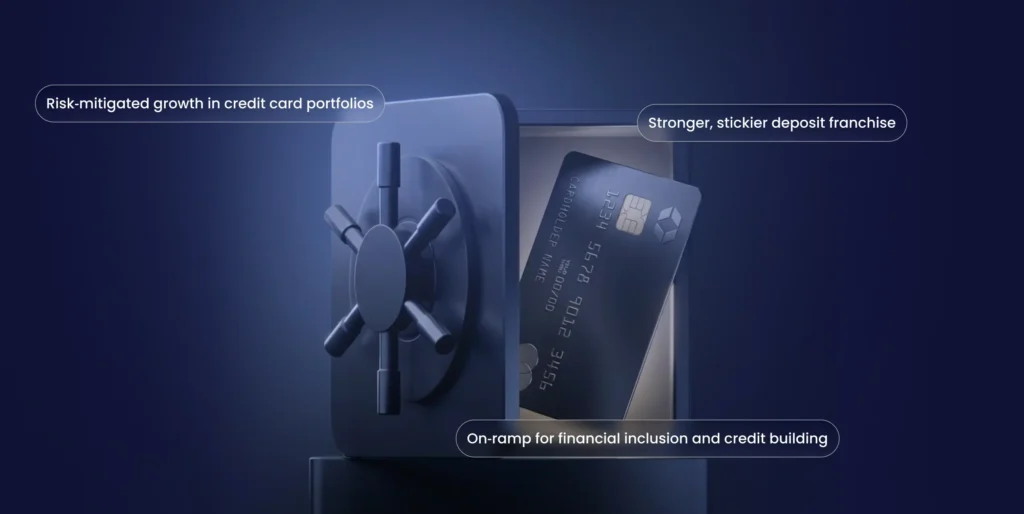
1. Risk‑mitigated growth in credit card portfolios
Because the exposure is backed by an FD, secured card portfolios are inherently more resilient in stress scenarios. This allows banks to:
- Grow card-in-force counts without proportionately increasing credit risk.
- Experiment with new customer segments or geographies with tighter risk controls.
- Maintain healthier portfolio metrics even as they expand into new-to-credit segments.
2. Stronger, stickier deposit franchise
Every FD‑backed card deepens the relationship with a customer by combining assets (deposits) with credit. Over time, this helps banks:
- Mobilise granular, stable deposits linked to card usage.
- Improve product per customer (PPC) by bundling savings, deposits, and cards.
- Reduce churn, since customers are less likely to move both deposits and cards together.
3. On‑ramp for financial inclusion and credit building
For customers, secured cards can be the first step into formal credit. They enable users to:
- Build or repair credit histories through disciplined card usage and on‑time payments.
- Access short‑term credit for everyday transactions, instead of informal or high‑cost options.
- Transition smoothly into unsecured cards once they establish a track record.
Secured cards are a practical way for thin‑file and new‑to‑credit users in India to build their score without taking on excessive risk.
Digital onboarding: The Real Unlock
The secured card construct is powerful, but the real unlock is how quickly and seamlessly a bank can take it to market. Modern, API‑first card stacks allow banks to:
1. Launch new credit card journeys in weeks
With a cloud‑native card platform, banks can configure eligibility rules, FD thresholds, limits, KYC flows, and card variants through low‑code setups instead of long custom builds. This can compress launch timelines from many months to a matter of weeks.
A recent case study shows banks using Hyperface to more than double card adoption by leveraging a modern, modular card stack integrated with their existing systems.
Read Hyperface’s case study on AWS for 100%+ card adoption boosts
2. Enable 100% digital onboarding for secured credit cards
Digital onboarding is particularly important for FD‑backed cards because the journey must orchestrate:
- FD creation and lien marking.
- Credit card approval and issuance.
- Virtual card provisioning and immediate usage in apps and on UPI rails.
A modern platform like Hyperface can power end‑to‑end digital flows where eligible customers get a secured credit card against their FD completely online within minutes. This not only improves conversion but also aligns with customers’ expectations of instant, app‑first experiences.
3. Compliance as a feature
Regulation around digital lending, KYC, and credit risk management is evolving quickly. A configurable platform helps banks embed compliance into the workflow with
- Dynamic rule engines for eligibility and risk checks.
- Audit-ready logs and consent management.
- Easy updates as guidelines change.
Banks can thus scale secured card programs confidently, knowing that both customer journeys and backend processes are aligned to current expectations.
How Hyperface enables secured credit card programs
Hyperface’s credit card platform is built to help banks launch, manage, and scale both unsecured and FD‑backed secured credit cards with speed and flexibility. Key capabilities include:
- API‑first onboarding journeys that connect deposits, core banking and card systems in real time.
- Configurable workflows for pre‑approved and deposit‑backed card issuance, including limit rules and risk controls.
- Instant digital card issuance and lifecycle management, enabling customers to start using their cards immediately in mobile apps and on UPI.
- Analytics and optimisation tools to monitor funnel performance and improve approval, activation, and spend metrics over time.
By combining secured credit cards with modern digital onboarding, banks in India can grow their card books prudently, deepen customer relationships, and extend formal credit access to millions of underserved customers — all while delivering the kind of smooth, app‑native experiences that users now expect.
Ready to redefine your credit card strategy?
Book a demo with Hyperface today to see how our API-first stack can help your bank launch a fully digital, FD-backed credit card program in weeks, not months.
 LinkedIn
  WhatsApp
  X (Twitter)